

Latest update: March 20, 2026
Note: Some passages in this article have been translated into English by machine and may be linguistically inaccurate. Freeontour does not accept any liability for the accuracy.
Denmark is a popular travel destination for campers - and there are a number of good reasons for this. As a beach holidaymaker in Denmark you have the choice between the Baltic and North Sea. On the latter you will find one of the most beautiful beaches in the country: Hvidbjerg Strand in the area around Blåvand in the municipality of Varde. Here you will not only find a wonderful campsite right on the seemingly endless beach, but also a lot to discover in the area. Wouldn't that be an idea for next summer?
Content
What does the Hvidbjerg Strand campsite on the North Sea offer?
Excursion to the Blåvand lighthouse
Discover fascinating architecture and history at the Tirpitz Museum
Walk to Bill Woodrow's peace sculpture on the beach
Drive directly onto the beach with a car or motorhome

What does the Hvidbjerg Strand campsite on the North Sea offer?
There are many beautiful campsites on Denmark's North Sea coast - but how about something very special? The campsite Hvidbjerg Strand Camping near Blåvand belongs to the holiday park of the same name and not only offers a direct connection to the sea and the dunes, but also a lot of additional options. After all, the campsite did not get its six stars for nothing. In addition to the usual standard pitches, the offer ranges from six other categories and price ranges to XL luxury pitches with space for two caravans, a private bathroom and an outdoor spa.

Campsite guests also have free access to the adventure pool, trampoline land and a large indoor play area throughout the season. Anyone over the age of 16 can also enjoy the wellness center for three hours a day from Monday to Thursday free of charge. If you don't have your own mobile home or caravan, you can also rent special themed huts here. These include, for example, fishermen's huts that stand on stilts in the water, Wild West huts or the so-called Hvidbjerg huts, which exude a modern Scandinavian flair.
In addition to the accommodation, the campsite also offers a whole range of leisure activities in the immediate vicinity. The perfect starting point to explore the region.

Excursion to the Blåvand lighthouse
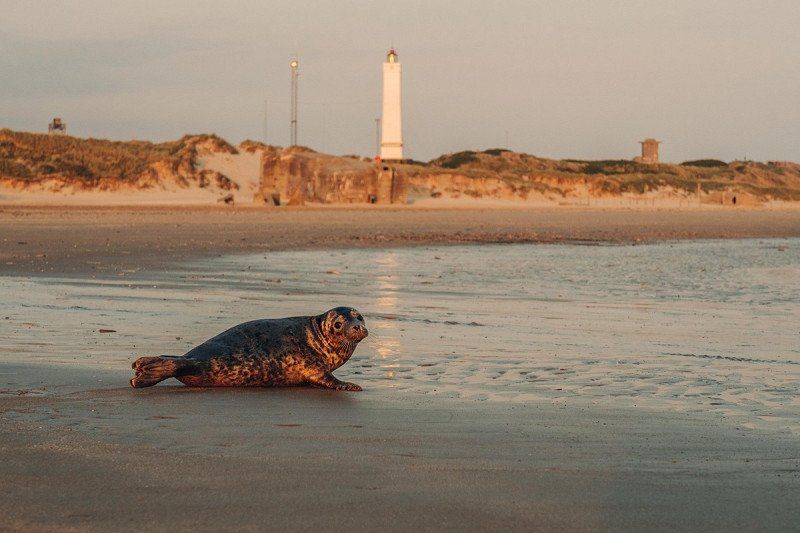
Blåvand lighthouse is one of the region's great landmarks, although the lighthouse is not that old yet. It was only put into operation in the year 1900. The best way to get from the campsite to the lighthouse is by foot or by bike. It only takes a quarter of an hour to get to the lighthouse from the beach by bike, and you can comfortably cycle along the coastal road. It takes about an hour to walk. And while you are already there, you should of course not miss the opportunity to take a look at the inside of the building. There are around 170 steps to climb to reach the top but it really is worthwhile: at a height of 39 meters you have a great view over the coast. In good weather conditions, you can even see the offshore wind farms. Also hobby photographers get their money's worth here, especially at sunset. Those interested in the history of the lighthouse will get more information in the attached museum, which is set up in the former apartment of the lighthouse keeper.
Directly at the lighthouse, there is also a large parking area that can be used free of charge by cars and motorhomes.
Discover fascinating architecture and history at the Tirpitz Museum
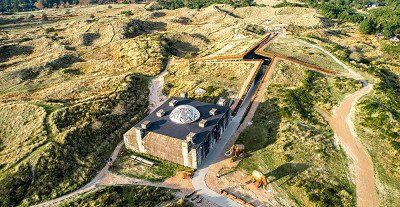
The Tirpitz Museum southeast of Blåvand is another eye-catcher from an architectural point of view and a great photo opportunity. It can be reached on foot in less than one hour from Hvidbjerg Strand. This gives you the opportunity to combine a hike through a wonderful dune landscape with a fascinating history excursion and outstanding architecture. The Tirpitz Museum was created by the famous architecture firm Bjarke Ingels Group, which over the past decade often has caused a stir with its spectacular buildings and the Tirpitz Museum is no exception in this regard.
The spectacular thing about the Tirpitz Museum, however, is that on first glance it looks completely inconspicuous and is barely visible. It is hidden under the sand of a protected dune landscape in Blåvand, so to speak. The modern building, which houses a mixture of nature and local history museum, is connected underground with a bunker from the Second World War. It is a remnant of the so-called Tirpitz Battery, which was supposed to be built as part of the German Atlantic Wall, but was never completed.
The exhibitions inside the Tirpitz Museum are definitely also worth a visit. In four different permanent exhibitions, stories are told with interactive and multimedia features about the everyday life on the west coast - for example camping life in the 1970s -, about life in the shadow of the Atlantic Wall during World War II, and about the amber found along the coast. In the historic bunker to the South, which was largely left to its own devices, there is still the feeling of goose bumps: the moisture in the gloomy concrete walls paired with the musty smell and various sound effects almost create a spooky atmosphere. One really is not ungrateful when climbing back out into the sun and the wonderful dune landscape.

Walk to Bill Woodrow's peace sculpture on the beach
If you want to treat yourself to some other kind of art, you should also make a detour to Bill Woodrow's Fredsskulptur (translated: Bill Woodrow's Peace Sculpture). It is another landmark of the Varde region and is located just a few minutes northwest of the campsite. Here the relics of the Atlantic Wall are still present. On the occasion of the 50th anniversary of the liberation of Denmark in 1995, the English artist Bill Woodrow turned some of the bunker remains on the beach at Blåvand between Skippervej and Lille Strandvej into mule sculptures. He mounted large metal mule heads and tails on four of the bunkers on the beach. The underlying symbolism: mules are sterile and cannot reproduce. On the beach of Blåvand they were installed as a memorial for the wish that the bunkers should never multiply again either. The sculptures are a real attraction and popular photo motif - especially at high tide when they partially disappear in the North Sea.

Drive directly onto the beach with a car or motorhome
That Denmark, and especially the Danish west coast, is a paradise for surfers is certainly nothing new. However, beginners will also get their money’s worth at Hvidbjerg Beach, as it offers perfect conditions to try out surfing for the first time: there’s plenty of space and you don’t have to expect overly large waves. Even the sometimes very strong wind is not a problem here.
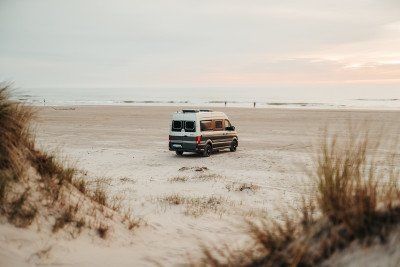
Those with a bit more surfing experience will love Vejers Beach and Børsmose Beach, just a few kilometers northwest of Hvidbjerg Beach: here you’ll find not only great waves, but you’re also allowed to drive directly onto the beach during the day with a car, campervan, or motorhome and unload your surfboard. The same applies, of course, to anyone who simply wants to enjoy a wonderful day at the beach.
For both, however, you should definitely keep an eye on the tides so that your vehicle doesn’t get wet feet. For this reason, overnight stays with a campervan or motorhome are not permitted on the two car beaches, Vejers Beach and Børsmose Beach. In return, the region along the Danish west coast offers several other campsites not far from the beach. Below there are some suggestions.